Ohio High School's AI Essay Detector Flags Shakespeare's Hamlet As 'Obviously Written By ChatGPT' During Literature Class Assignment
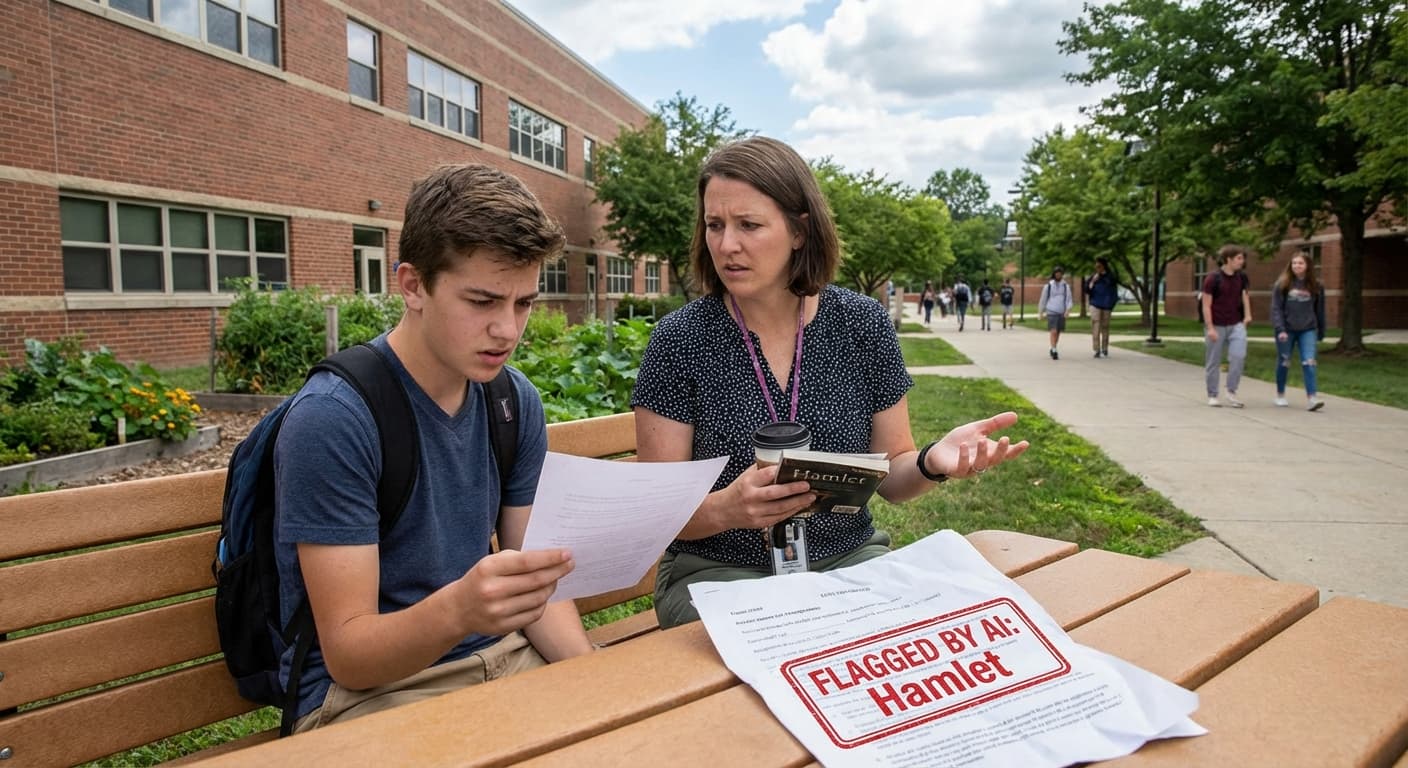
COLUMBUS, OH — Students at Roosevelt High School's Advanced Placement English Literature class received failing grades on their Hamlet analysis papers...
COLUMBUS, OH — Students at Roosevelt High School's Advanced Placement English Literature class received failing grades on their Hamlet analysis papers last week after the school's AI detection software flagged Shakespeare's original text as "artificially generated content with 97% confidence," according to district records obtained by the Columbus Board of Education.
The incident occurred when English teacher Margaret Sullivan uploaded students' essays to TruthScan Academic, a $2,400-per-year software package designed to identify AI-generated writing. As part of her standard verification process, Sullivan also submitted the assignment prompt along with passages from Hamlet that students were required to analyze and quote.
TruthScan's algorithm immediately classified the 400-year-old play as "sophisticated AI-generated text exhibiting clear signs of large language model composition," citing "unusually complex metaphorical structures," "non-conversational dialogue patterns," and "statistically improbable vocabulary density for human authors."
"The software flagged lines like 'To be or not to be, that is the question' as 'formulaic philosophical prompt engineering," Sullivan explained. "It also marked the entire 'What a piece of work is man' speech as 'clearly generated humanities content designed to appear profound.'"
The detection algorithm's analysis noted that Hamlet's soliloquies contained "AI-typical patterns of abstract reasoning" and "the kind of perfect iambic pentameter that humans rarely achieve without computational assistance." The software specifically highlighted Polonius's advice to Laertes as "obviously AI-generated life coaching content."
Fourteen students who had correctly quoted and analyzed the flagged passages received automatic zeros for "academic dishonesty through AI collaboration." The system also recommended they attend a mandatory workshop on "ethical writing practices in the post-human era."
Dr. Thomas Mitchell, Roosevelt High's principal, initially defended the software's accuracy. "TruthScan has a 94% success rate in identifying AI content," Mitchell stated. "If it says Shakespeare sounds artificial, maybe we need to reconsider what we think we know about authentic human expression."
The situation escalated when TruthScan also flagged excerpts from the King James Bible, the Declaration of Independence, and Martin Luther King Jr.'s "I Have a Dream" speech as "probable AI output" during Sullivan's additional testing. The software's confidence ratings remained above 90% for all historical texts.
TruthScan's developer, AcademicGuard Solutions, acknowledged the false positives in a statement. "Our algorithm is trained on contemporary student writing patterns," explained Chief Technology Officer Dr. Lisa Park. "Historical texts that demonstrate exceptional rhetorical sophistication may trigger our detection protocols because modern students typically don't write at that level without AI assistance."
The Roosevelt High incident has prompted the district to suspend AI detection requirements pending further review. "We're in the awkward position of having to prove that Shakespeare didn't use ChatGPT," Sullivan noted. "I never thought I'd have to defend the authenticity of Hamlet, but here we are."
Advertisement
Support The Synthetic Daily by visiting our sponsors.