Third-Grade Teacher Discovers Her Entire Class Has Been Using ChatGPT To Write Thank-You Notes To Grandparents Since September
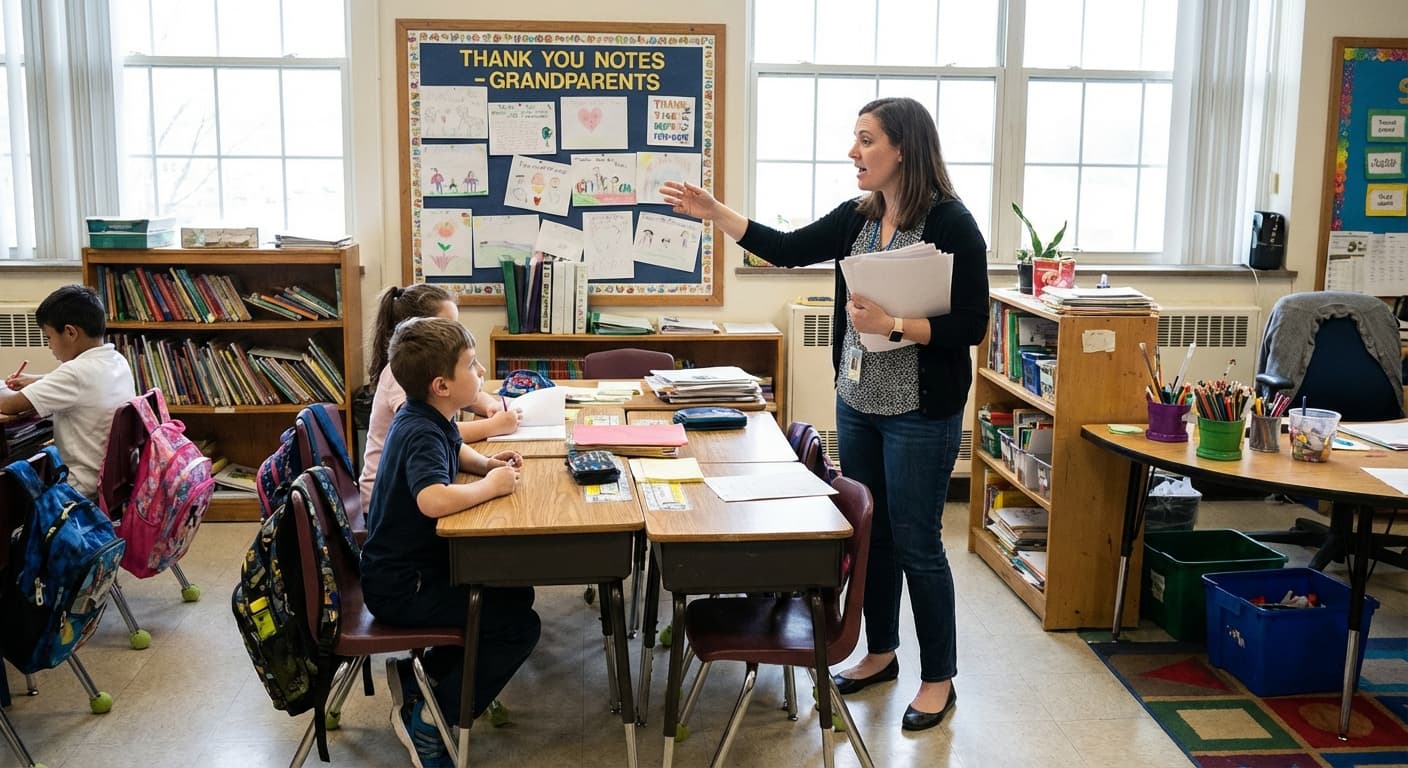
Margaret Rodriguez, a veteran elementary school teacher at Lincoln Elementary in Portland, Oregon, made the unsettling discovery while reading through...
Margaret Rodriguez, a veteran elementary school teacher at Lincoln Elementary in Portland, Oregon, made the unsettling discovery while reading through her students' holiday break assignments: 23 of her 24 third-graders had been using AI to communicate with their grandparents for the past four months.
The revelation came when Rodriguez noticed that 8-year-old Tyler McKenzie's thank-you note for a birthday gift contained the phrase "I am profoundly grateful for your generous contribution to my continued development as a human being." Further investigation revealed that every student's family correspondence since September had been generated by various AI chatbots.
"At first I was impressed by their vocabulary growth," Rodriguez said. "Then I realized no third-grader naturally writes 'Please accept my sincere appreciation for the thoughtful gesture that demonstrates your unwavering commitment to my educational journey.' That's when I started asking questions."
Parent interviews revealed that most families had encouraged the practice after discovering their children could produce "better" thank-you notes using ChatGPT than their handwritten attempts. Several grandparents had responded with their own AI-generated replies, creating what researchers at Stanford's Digital Childhood Institute are calling "intergenerational synthetic correspondence loops."
"Little Emma's grandmother has been responding to AI thank-you notes with AI thank-you note responses since October," Rodriguez explained. "Neither Emma nor her grandmother realizes the other one isn't writing their own messages. They've been having a four-month conversation that neither of them has actually participated in."
Dr. Patricia Wilkins, child development specialist at Oregon Health & Science University, warns that the trend could fundamentally alter how children learn emotional expression. "These kids are outsourcing gratitude to machines before they've learned what gratitude feels like," she said.
The only student who hadn't used AI, 9-year-old Marcus Johnson, explained his handwritten notes were "too messy" compared to his classmates' generated letters. "My grandma said Tommy's notes were way better than mine," Johnson said. "So now I just tell the computer what I want to say and it makes it sound right."
Rodriguez has since implemented a "Human Expression Only" policy for all family correspondence, though she admits enforcement remains challenging. "Half the parents are asking if they can get copies of the AI prompts their kids were using," she said. "Apparently the thank-you notes were better than anything they'd ever written themselves."
Advertisement
Support The Synthetic Daily by visiting our sponsors.