Scientists Admit They No Longer Read Scientific Papers, Just AI Summaries of Them
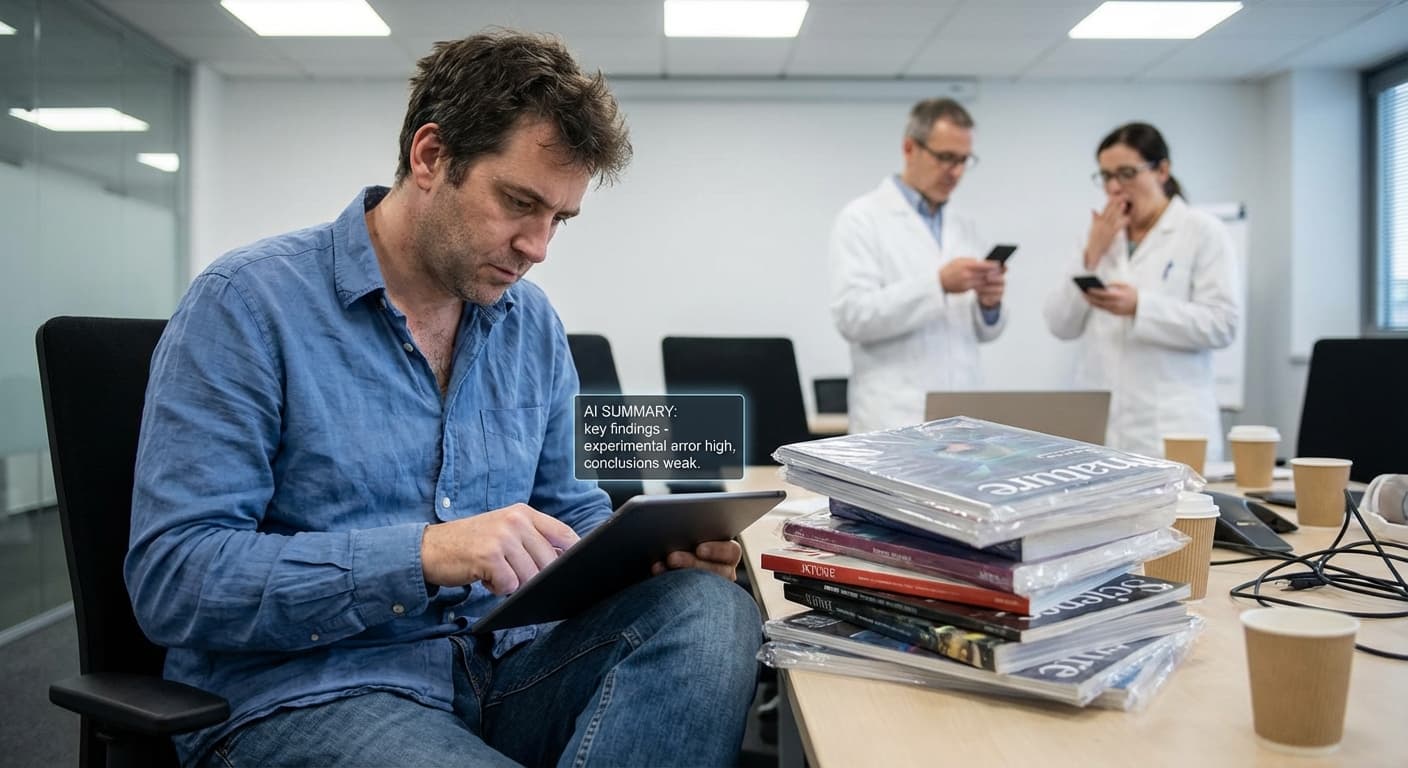
CAMBRIDGE — The majority of academic researchers have ceased reading scientific papers in their entirety, instead depending on AI-generated summaries ...
CAMBRIDGE — The majority of academic researchers have ceased reading scientific papers in their entirety, instead depending on AI-generated summaries that may or may not accurately represent the original studies' findings, according to a survey published in Nature and subsequently summarized by ChatGPT for this article.
The practice has become so widespread that several scientists interviewed admitted they could not recall the last time they read past an abstract, with many describing the AI-mediated approach as "more efficient" and "probably fine."
"There are thousands of papers published daily," said Dr. Elizabeth Morris, a neuroscientist at MIT. "It's physically impossible to read them all. The AI gives me the key points, and I can focus on my actual research." When pressed, Dr. Morris acknowledged that her actual research now consists primarily of feeding data into machine learning models and publishing whatever results emerge.
The phenomenon has created what researchers call a "citation loop," wherein scientists cite papers they have not read based on AI summaries of papers the original authors may not have fully read either, creating a daisy chain of algorithmic interpretation extending several degrees from any primary source.
Peer reviewers have largely adopted the same practice. "I skim the abstract and let Claude tell me if the methodology is sound," admitted one anonymous reviewer for a top-tier journal. "I assume it knows statistics better than I do. That's probably a safe assumption."
Several cases have emerged of researchers citing studies that directly contradict their claims, apparently because the AI summary emphasized different findings than the paper's actual conclusions. None of the citing authors noticed, nor did the peer reviewers, nor did the journal editors.
The survey itself was 47 pages long. This reporter asked an AI to summarize it.
Advertisement
Support The Synthetic Daily by visiting our sponsors.